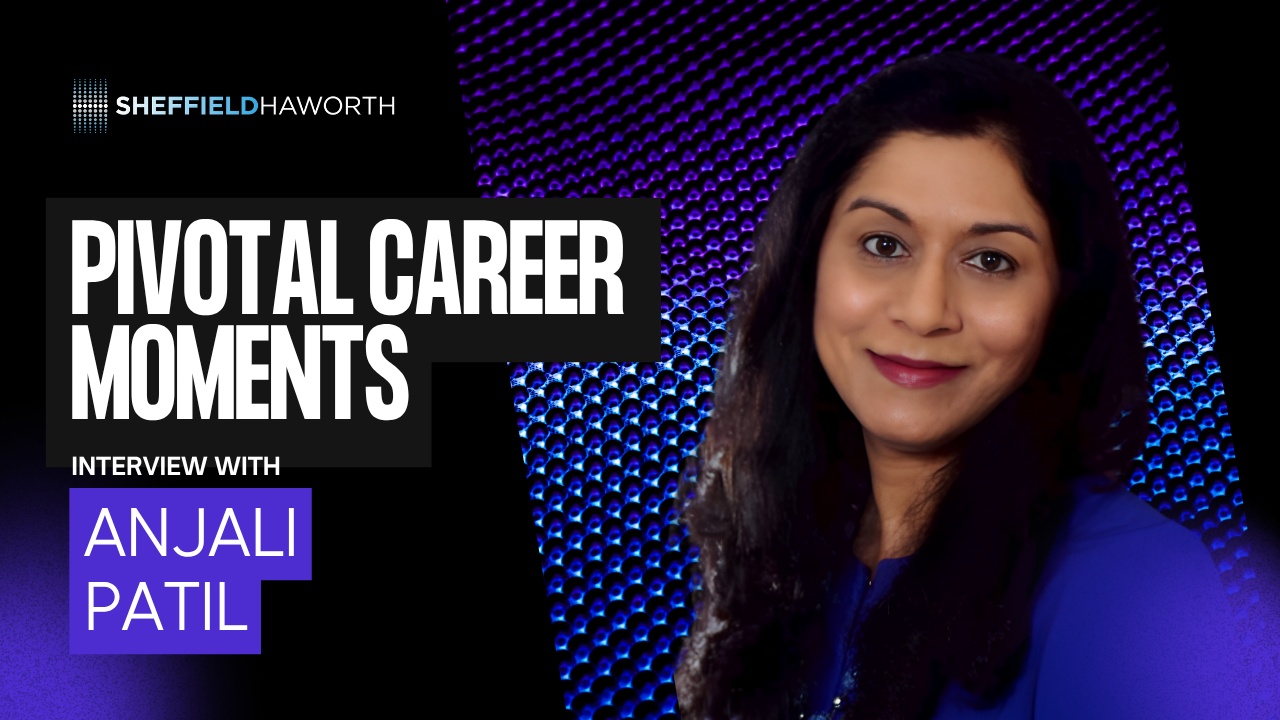
Introduction to the Interview
In Sheffield Haworth’s Pivotal Career Moments series, we spotlight the defining milestones and transitions that shape the careers of inspiring leaders of industry.
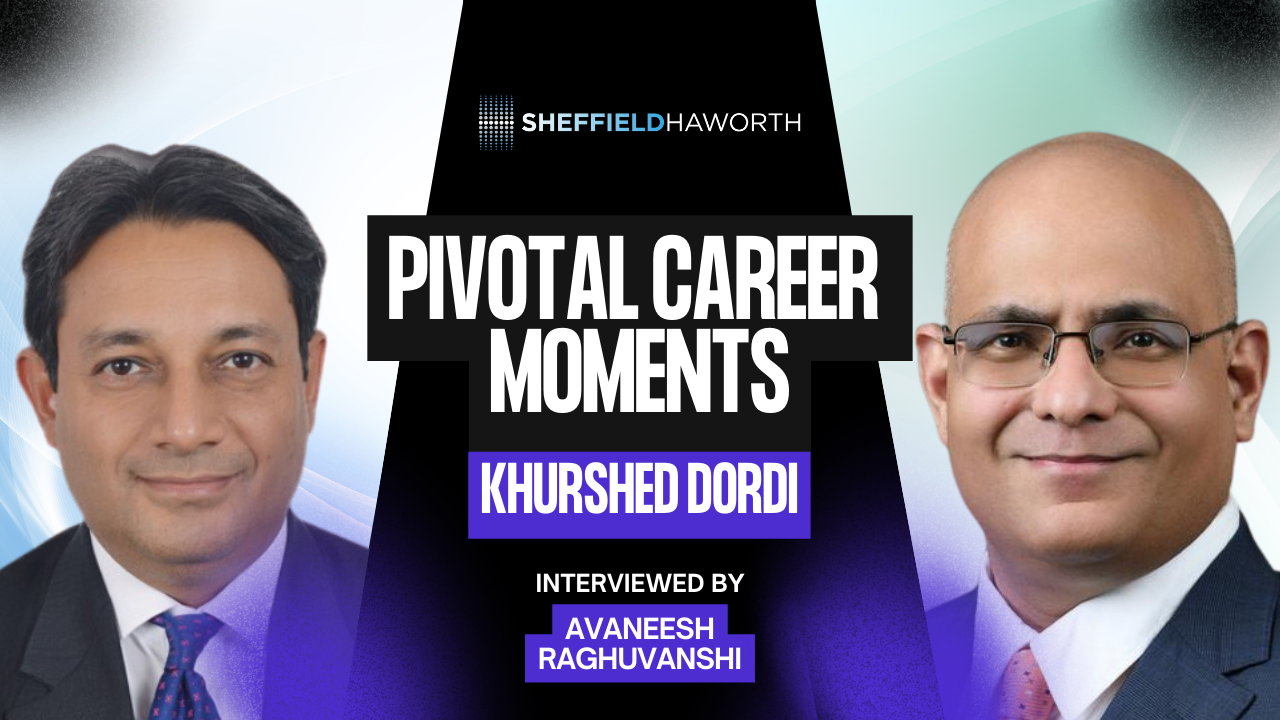
In this instalment, Avaneesh Raghuvanshi speaks with Anjali Patil, a strategic communications leader with over 30 years of experience as custodian of global financial services brands including BNP Paribas, Fidelity International and Morgan Stanley. Anjali built her career across India and Southeast Asia, managing external communications, reputation and crisis management, media relations, sponsorships and events, internal communications, CEO positioning and corporate philanthropy. She now works as a consultant and executive coach.
The Interview
Avaneesh: Anjali, to start us off, could you introduce yourself in your own words and give us a quick picture of the work you’ve done across your career?
Anjali: To borrow from banking, I am a career communicator. I’ve spent over 30 years in communications, mostly within financial services with two stints on the agency side. I was privileged to have been associated with truly marquee, global brands.
If that ‘quick picture of my work’ were a word cloud, here are the words I’d add – Morgan Stanley, Fidelity, BNP Paribas, Ogilvy PR, Cadbury, Roland Garros, French Open, Rolls Royce, Mercedes Benz, Boeing, Bosch.
My primary expertise is reputation management and crisis communications. I have equally enjoyed brand building, especially corporate brands, and corporate philanthropy.
I’ve been fortunate to work in companies where reputation management mattered enough that I reported to the CEO/Country Head directly from the early years of my career. I’ve always enjoyed roles that gave me the freedom to mould the reputation of a company, while being mindful of the guardianship aspect as the custodian of reputation. And equally the autonomy to shape local strategy, because while the companies were global powerhouses, they understood that local nuances cannot be underestimated in corporate communications.
Avaneesh: When you think back over your career, what would you say are the most significant challenges you’ve had to overcome?
Anjali: When you work in banking and the financial sector, you are very fortunate if you have a boss/manager who understands the strategic value of communications. And I’ve been very lucky on that count throughout my career.
But, even with that support, you can still have a challenge with internal stakeholders or internal clients as I call them. The reason is because not everyone understands the full scope of corporate communications and what it can achieve. They appreciate the more visible aspects, e.g. an interview that is published and noticed by their clients, a social media post that gets a lot of engagement or an annual investor conference. The challenge lies in building support for initiatives where the RoI is not immediately evident, but which can contribute significantly to corporate reputation, e.g. thought leadership programmes or change communications campaigns. So that’s a challenge I ran into at all the firms where I have worked.
Another challenge that I relished was setting up the communications function for the India geography/operations of these global firms – as I remember it I did that at three companies.
Avaneesh: What does strategic communications look like in real life, day to day?
Anjali: Sometimes it can be as prosaic as answering query after query with unwavering messaging discipline, finding the patience to explain the firm’s approach over and over again until the perception shifts to a positive one. And it can be strategic when you are delineating brand positioning or crafting messaging in high stakes situations and securing buy-in for it from multiple stakeholders, or creating ESG communications strategy that has to withstand the scrutiny of civil society groups or shaping an empathetic internal communications narrative on sensitive issues when faced with employee activism.
Avaneesh: Was there a moment early on that really shaped you?
Anjali: I remember two such moments from my time at Morgan Stanley. When I joined, the firm was grappling with the fallout from a crisis that had occurred a couple of years earlier. And that led to a constant stream of media articles and media queries around every action that could be construed as market making – wrongly so, because when it came from investment management it was selling or buying on behalf of the fund, when it originated in global markets, it was on client instructions and if it was MSCI altering weightages, it was simply a matter of rebalancing the index. Some of these resulted in articles that were not favourable.
One time, there was a negative article with a big headline that took me by surprise because the journalist had not reached out for comment. I was worried about the Country Head’s reaction when I went to discuss our response with him. He calmly asked me whether the news report was factually correct. I said yes, having confirmed it with the respective division. He simply said, “Ok then. Go ahead and prepare our response.”
No drama, no berating journalistic standards. It was a great lesson that taught me to focus on facts and actions even when things were stacked against us, whether rightly or not.
The second moment that stayed with me throughout my career was during my first meeting with the Head of APAC Communications – one of my two bosses. He told me that if I thought that the Country Head had a different opinion than mine on handling media queries, I had to be firm and explain how it might play out. Essentially, he was telling me that I should get the Country Head to defer to my judgment! I was not senior enough and he was an MD. Why would he listen to me, I asked. And he said, “You are the custodian of the brand, of our reputation. If something causes you concern about the impact on the brand, then you have to speak up.”
That sentence became a reference point for me. Communications isn’t just messaging. It’s judgement and stewardship.
Avaneesh: You mentioned the agency side too. Were there any pivotal moments there?
Anjali: The one that stands out is a food industry crisis that I managed when I was at Ogilvy PR India.
It was in 2003 that some consumers found worms in the packaging of Cadbury chocolates. The damage to the brand from those visuals playing in loop across national television channels was immense. And sales dropped during a peak, festive season. I was the lead for crisis communications and media relations. Working with the company’s senior management allowed me to witness first-hand how a crisis galvanises a company to make changes and implement them in record time. And I got to work alongside Ogilvy Advertising on the campaign to rebuild the brand and its reputation.
There was a lot to learn and even today it remains an award-winning case study.
Avaneesh: You’ve had a lot of transitions too, including geography. How do you think about transitions now?
Anjali: When I look back, I see the transitions through different lenses – one is between corporate and agency life, while another is between very different organisational cultures – for example a French bank versus an American investment manager. And then there’s geographical transitions, moving from India to Singapore to lead communications across Southeast Asia.
But I don’t think of these moments as transitions in a dramatic sense. I think what helps is staying focussed on your objectives, on the reasons why you took up the role, what you are learning – not just about the job but about how things get done or rather how people get things done. Accepting the change, learning and adapting – I think that is the key.
And sometimes, the biggest transition is not one of your choosing and not one that presents itself as a transition. You have the same role and the same title, but then there’s a new boss with new priorities and new ways of working, and suddenly it feels like a whole new job. I’ve always thought: new stakeholders equals new job, even if it’s technically the same seat.
My learnings from these lived career experiences is what I bring to my coaching practice, especially in Career Transitions coaching. And that is also my most recent transition – from corporate life to an independent practitioner.
Avaneesh: What helps you handle those shifts, especially in large institutions?
Anjali: I think it is not making a “thing” out of making the shift or adapting to a new organisational culture. You go through a fairly long interview process, you meet a lot of future colleagues during that time and you begin to sense the differences. Once you make the decision to go work for a company, I think the culture goes with the territory.
Accepting that it is going to be different, having the patience to observe and learn how things get done, finding allies early on help to smoothen the transition.
Equally important is building relationships, creating trust, understanding what different stakeholders need, and how they think. This came to me easily – it’s at the heart of corporate communications.
Having spent years in large, complex financial institutions and managing internal communications, I found that an organisation can contain multiple cultures within it. Of course, there is an overarching corporate culture, but a global markets trading floor is very different from, say wealth management. So, there’s shift even if you take on a new role within the same organisation.
Avaneesh: You’ve done a lot around philanthropy, particularly culture and social inclusion. Why do those areas matter so much to you?
Anjali: At a personal level, it matters for simply being able to drive initiatives that make an impact in the community. I am truly grateful for having had the opportunity to partner several NGOs and cultural organisations in India and Southeast Asia.
In my role, I could see that these initiatives help shape organisational culture in a very real way. Philanthropy and volunteering help break down silos. Team building activities are helpful, but volunteering is different because it is rooted in a shared purpose. Colleagues meet each other outside the usual hierarchy and day-to-day pressures with a common goal of giving back to the community with their time and skills. I have seen that bond become stronger among colleagues who, otherwise, would never have interacted with each other.
And younger employees really want to see organisations giving back. Community initiatives that make a demonstrable difference and are well-articulated contribute to building a strong employer brand.
Avaneesh: You also mentioned sponsorships and supporting culture. What did that look like in practice?
Anjali: Art and Culture was one of the pillars of BNP Paribas’ philanthropic activities and I had the privilege of building partnerships with renowned organisations in contemporary dance, jazz and western classical music. Again, it was not about financial contributions or sponsorships alone. As a communications professional, you are looking for ways in which to take this to multiple stakeholders. Hosting clients at performances and concerts is an obvious one. But, we also looked for other ways to expand it.
One example is the support we brought to the late Astad Deboo, a pioneer of contemporary dance in India. BNP Paribas’ support went beyond contributing to the creation of new works and extended to his initiative of teaching dance to students of deaf schools. And in Singapore, BNP Paribas sponsored the Esplanade’s annual dance festival, which featured a group of dancers with disability. That dance group was truly inspiring and we ensured that our Disability Inclusion ERG was involved. Another time, when we supported the Singapore Ballet, we had two ballerinas at our International Women’s Day event talking about gender issues that they face. It was surprising to hear about that because women are the face of ballet and you just assume that they have it easier than women in the corporate world.
Avaneesh: There’s a thread here about communications becoming more strategic. Have you seen the role change over time?
Anjali: Over the span of my career, I have seen communications evolve from a tactical function focussed on media relations with a one-way information flow to a more strategic one. With the rapid rise of social media, the brand, and I would say, even reputation, became a conversation. And what was said was instantly accessible around the world. In face of that change, communications evolved as a function shaping organizational reputation, advising leadership on stakeholder expectations, and helping navigate complex issues before they become crises. It has moved closer to becoming a “trusted advisor” to the CEO.
As for me, in the first few years of your career, you don’t necessarily think you’ll be working at senior levels. But I was lucky very early in my career on two counts – one, reporting to the CEO and not the Head of Marketing and two, being part of operating and executive committees. That kind of access gives the communications function a voice in the room where decisions are made. And you have to step up by bringing a more strategic approach, one that manages the risk to the reputation while continuing with initiatives that strengthen it.
Avaneesh: And what about AI? How do you see it changing communications?
Anjali: AI is changing how communications teams work, particularly by improving efficiency in areas such as drafting content, tracking media coverage, monitoring conversations, and synthesizing large volumes of information quickly.
But, my view is that it can’t replace the strategic core of the role. Communications often involves judgement calls, especially in sensitive situations or during a crisis, where context, experience, and an understanding of human dynamics are critical. Decisions about tone, timing, and credibility still require professionals who understand stakeholders and can advise leadership with confidence.
One area I do think the profession will need to think about carefully is the impact on early-career development. Traditionally, young professionals learned the craft through the more operational aspects of the job. As AI automates a large part of that “grunt work,” we will need to be more intentional about how people build the instincts and judgement that come with experience.
Avaneesh: If you had to boil it down, what are the skills you think will always matter in senior communications roles?
Anjali: At the most senior level, a few capabilities matter regardless of how the tools or channels evolve.
First is judgement. Communications leaders are often advising in moments of uncertainty, when reputational, commercial, and human considerations intersect. You need the ability to step back, assess the situation clearly, and guide leadership toward decisions that are credible and responsible.
Second is the ability to read the room – understanding how people will react, where resistance may appear, and how to navigate those dynamics.
Third is internal networking to build influence with stakeholders. This is underestimated, but in large organisations, managing high visibility projects is all about bringing stakeholders along, building support and alignment, and having the patience to stay the course.
Avaneesh: Finally, what feels pivotal about this stage of your career?
Anjali: I’ve moved into independent consulting, and that’s been a significant change after more than three decades in the corporate world. I am really enjoying the flexibility in how and where I work, choosing projects that leave me with time for family and personal interests. It does feel like starting from scratch in many ways, but that challenge is energizing.
While I continue to consult within the field of strategic communications, I have also added another dimension with my practice as an executive coach. My approach is that of Coaching through Story that blends proven coaching techniques with my career-long work in crafting narratives.
In Conclusion
Thank you Anjali for taking the time to speak with us. Anjali’s career is a reminder that pivotal moments are not always the obvious promotion or job change on paper. Sometimes they are the crises that test your judgement, the stakeholder shifts that quietly redefine your role, or the values-led programmes that change how people experience an organisation from the inside.
About the Interviewer
Avaneesh Raghuvanshi is Executive Director and Head of Sheffield Haworth’s Financial Services & Private Equity practice in India. He advises clients across Financial Services and Private Equity on senior leadership appointments, partnering with organisations and investors as they build leadership teams for growth and transformation.