Listen to the audio version of this article (generated by AI).
Introduction to the Interview
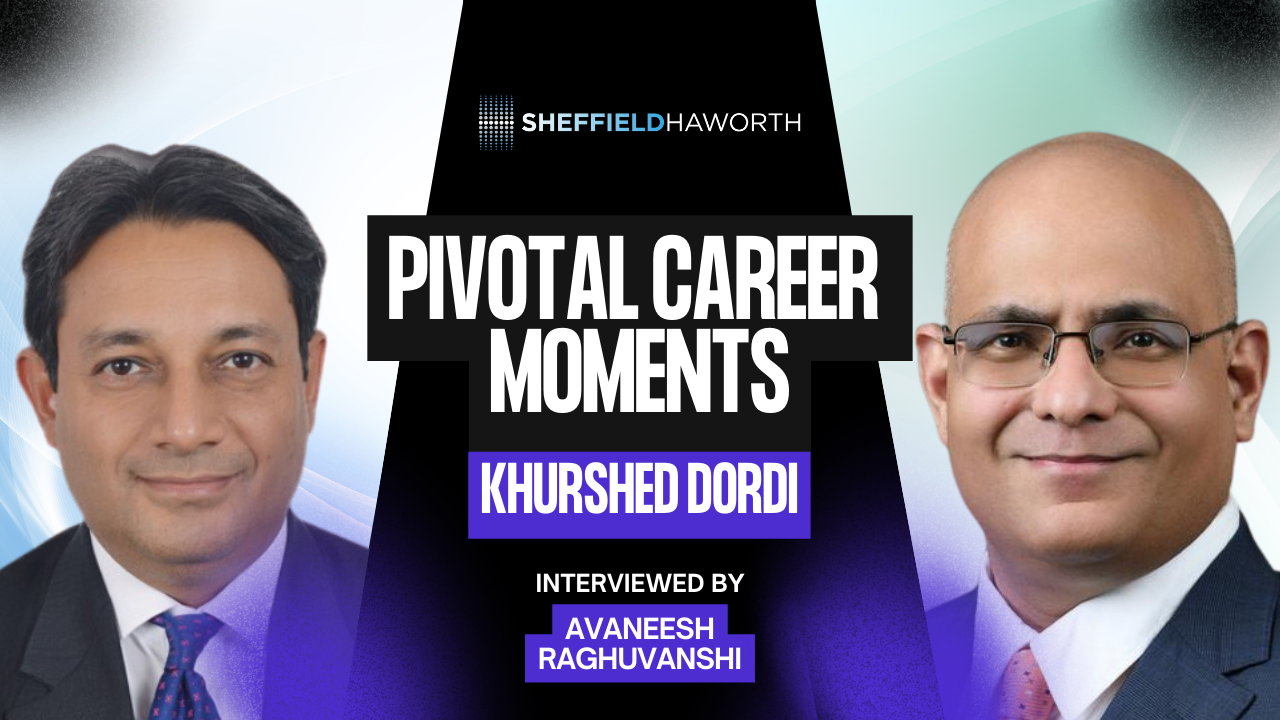
In the Sheffield Haworth Pivotal Career Moments series, we spotlight the defining milestones and transitions in the careers of prominent industry figures. In this instalment, Avaneesh Raghuvanshi, Head of our Financial Services & Private Equity practice in India, speaks with Khurshed Dordi, Founder of NortheStar consulting and formerly a top Deutsche Bank executive in India, rising over 24 years with the bank to Group COO, Business Head for GCCs, and serving as interim Group CEO. Khurshed shares thoughtful insights gained from a rich career, as well as his excitement about advising some of India’s fastest growing companies. We also got to discuss his new book The Art of Conversation, a best-selling exploration of communication as a leadership superpower.
The Interview
Avaneesh: When you think back over your 24 years at Deutsche Bank and now your transition into consultancy, what were the most significant challenges you had to overcome, both within a global institution and later as a founder helping others grow?
Khurshed: The hardest part was, in some way, changing my professional identity.
At Deutsche Bank, I was responsible for managing large and complex ecosystems. Capital, people, and risk. Success was defined by reliability and precision. When you become a founder, the definition of success shifts completely. Suddenly, the work is about creating frameworks that help other people grow, rather than being the one expected to provide the answers.
You know, there have been three big moments in my life that really shaped who I am today. The first one was learning how important it is to stay calm during market turbulence. I realised that speed without clarity just leads to chaos.
Then there was this huge shift in India, where we moved from being just a support centre to becoming a strategic hub. It was all about changing our mindset from just focusing on costs to really valuing what we bring to the table.
And the last turning point was what I like to call the talent flywheel. Instead of just celebrating individual superheroes, we made a shift to building strong leadership teams that could actually grow and scale. It was a game-changer
My job evolved from delivering answers to designing systems that continue to produce good answers long after I am out of the room.
Avaneesh: You emphasise the importance of people and culture in driving performance. Looking back, when were those beliefs tested or reaffirmed?
Khurshed: Culture is how people behave when the spreadsheet is not watching.
During a major restructuring, you have a choice. You can take the traditional top-down approach, or you can be radically transparent. We chose transparency. It was uncomfortable and at times messy, but trust grew.
Another moment came when we were aligning teams across London, Singapore, and Mumbai. We learned that collaboration cannot be mandated, but rather it has to be designed. Culture resides in the rituals you repeat, the incentives you establish, and the stories you share. When those elements align, performance follows. When they do not, you get bureaucracy instead of belief.
I’ve always said, values are easy to write down, but it is enforcement that creates culture.
Avaneesh: Many leaders in established organisations struggle to recognise when it is time for reinvention. How can professionals identify the external forces that signal a pivotal moment in their careers?
Khurshed: The time for reinvention rarely arrives with a shout. It whispers.
There are three dashboards I always encourage leaders to watch. Market signals, technology shifts, and talent behaviour. If your customers are outgrowing your strategy, if your technology is falling behind, or if your best people stop challenging you, you are already behind.
If two out of three begin to blink amber, start a ninety-day sprint. Explore, experiment, and embed change. Don’t wait for the perfect plan. Rather start with the next right question and go from there, step-by-step.
It’s time to shift strategy when your customers, your code, or your top talent start whispering. It’s your job to listen before they shout.
Avaneesh: You have created pivotal moments for yourself by launching NortheStar and publishing your book. What advice would you give others about creating those moments rather than waiting for them?
Khurshed: My advice is don’t wait for the wave. You should be the one shaping the break.
When I left Deutsche Bank, I wasn’t looking for a second act. I wanted to build a new platform. So I asked myself three questions: What am I uniquely good at? What excites me every day? And what problems can I solve for others?
Those questions shaped Northestar. It is built around three pillars: diagnosis, design, and disciplined delivery. I turned my experience into frameworks like SCORE and PIVOT, and created products such as The Art of Conversation that live beyond me.
Pivotal moments aren’t just found lying around. They are built and shaped.
Avaneesh: Your book focuses on communication as a leadership superpower. How can strong communication help people embrace or create pivotal moments in their careers or teams?
Khurshed: If you are clear in your communication, you give people the space to be courageous.
Leaders today do not need to communicate more. They need to make meaning. I use a simple model called Head, Heart, and Hands. Head is the logic. Heart is the empathy. Hands is the first next step.
Communication done well does not simply inform. It inspires movement. If you cannot explain something simply, you will never sustain it culturally.
Avaneesh: You have demonstrated how leadership grounded in care and inclusion can transform culture. How can organisations create environments that encourage empathy and authenticity, especially in a noisy digital age?
Khurshed: My view is that the best cultures are quiet but consistent and repeatable.
In my teams, we institutionalised care through rituals. Short win-and-learn meetings. Mentorship circles. Recognition loops that celebrated collaboration. Empathy must be measurable. That includes no-meeting zones, reflection hours, and leaders who set boundaries for themselves.
When empathy becomes an operating system rather than a campaign, engagement soars. Trying to embed empathy without mechanisms is just releasing a memo.
Avaneesh: Looking ahead, both as a consultant and an author, what pivotal moments do you hope to create next?
Khurshed: My focus now is to grow and expand, but not through projects, through people.
My aim or vision is to help build one hundred board-ready CEOs across India and Asia who lead with conscience. I want India’s Global Capability Centres to shift from execution engines to world-class transformation partners. And I would love to take The Art of Conversation into universities so that young professionals learn presence, empathy, and confidence early in their careers.
My goal really is to make myself obsolete by multiplying capable leaders. It’s a passion of mine to develop future leaders.
Avaneesh: If you could go back to the beginning of your career, what pivotal moment would you try to create, and what might you navigate differently?
Khurshed: Great question. I would take on the tougher roles earlier, particularly risk, audit and governance. Those are the places where judgment and courage are forged.
I would also build a personal board rather than relying on a single mentor. You need a strategist, an operator, and a humanist. People who challenge different dimensions of who you are.
And I would start writing earlier. Writing forces clarity and discipline.
I would seek more discomfort, but with a safety net.
Avaneesh: For someone reading this who is still early in their journey, what one piece of advice would you share?
Khurshed: Be unreasonably curious!
Deliver something tangible every month. Share what you learn. Teach someone else. Successful careers emerge when curiosity meets consistency. Don’t just chase titles. Chase momentum and mastery and make your progress public.
Avaneesh: You have seen leadership evolve across decades. What gives you optimism today?
Khurshed: We are moving into an era where authenticity outperforms authority.
The leaders who will define the future are the ones who combine competence with care. Those who balance clarity with compassion. Titles don’t build institutions. Behaviours do.
Khurshed's Top 3 Insights for Global Leaders
- Reinvention is just awareness in action. Watch your market, your tech, and your talent.
- Culture is all about architecture. Build rituals, incentives, and stories that truly align.
- Communication equals clarity. Say it simply, act visibly, and listen deeply.
In Closing
Thank you, Khurshed, for sharing your journey, insights, and the passion behind your new mission. Your story is a compelling example of how pivotal career moments can transform not only an individual’s path, but also help develop the next cohort of capable, honest and compassionate business leaders powering India’s development.
This interview is part of Sheffield Haworth’s “Pivotal Career Moments” series, where we explore the defining milestones that have shaped the careers of industry leaders. We hope Khurshed’s insights inspire you to pursue your own transformative journey.
About the Interviewer
Avaneesh Raghuvanshi is an Executive Director and Head of Financial Services and Private Equity Practice in India, overseeing and driving executive search initiatives. With an illustrious career spanning over 25 years, Avaneesh brings a wealth of experience in CxO-level searches for Financial Services clients and Private Equity funds, including their portfolio companies.
The Pivotal Career Moments series aims to highlight the key milestones and lessons learned by top professionals, offering valuable insights into leadership, resilience, and career progression.